 AI Tool Watch

AI Tool Watch
Plain-English reference for AI capabilities, plans, constraints, and implementations — for humans and agents.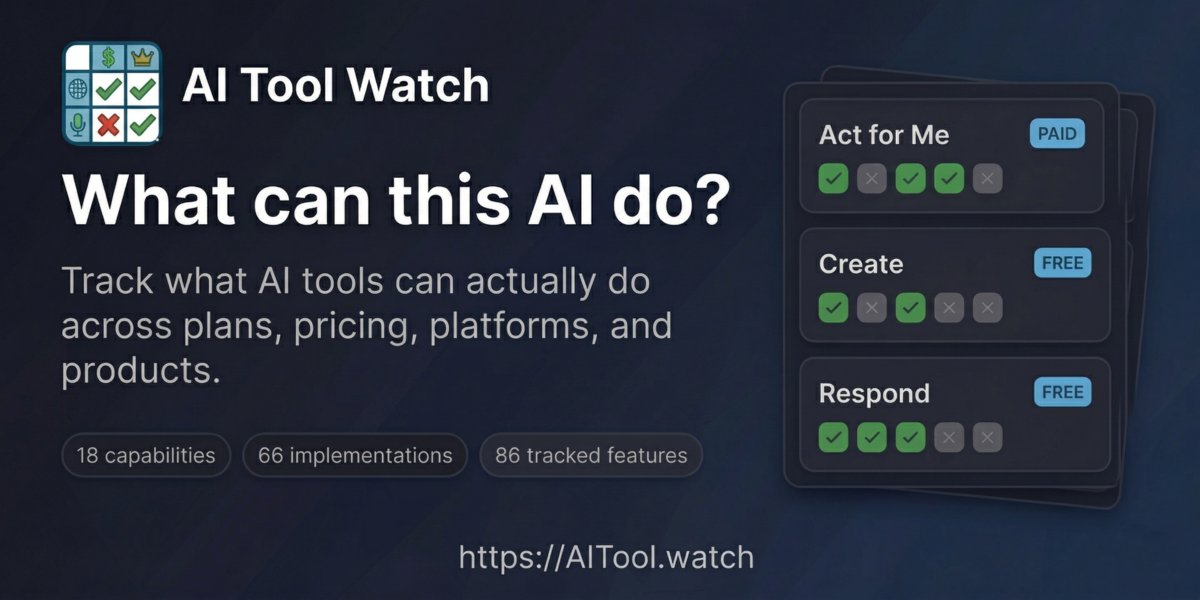
Who this is for
Anyone — humans or agents — who needs current, plain-English answers about AI tool capabilities, plan gates, and constraints before committing to a tool.
What problem it solves
AI tool capabilities, plan limits, and constraints change constantly and are scattered across marketing pages. AI Tool Watch is a single, verified, plain-English reference for humans and agents.
Canonical URL
https://aitool.watch/
What is this?
A single source of truth for answering questions like:
- "Is ChatGPT Agent Mode available on the $8/mo plan?" (No, Plus or higher)
- "Can I use Claude Cowork on Windows?" (Yes, macOS and Windows x64)
- "Which open/self-hosted models can I realistically run on my hardware?" (Depends on VRAM)
Built for AI facilitators, educators, developers, and AI agents that need accurate, current information about AI tool availability. Browse the site, query the JSON API, or connect an agent via MCP.
How it's built
There is no database, no framework, and no dependencies. Every piece of data lives in plain markdown and YAML files under data/. A single zero-dependency Node.js script (scripts/build.js) reads those files and generates the entire site — HTML pages, JSON API, bridge pages, sitemap — into docs/.
That's the whole stack: markdown files, one build script, and Git.
Contributing doesn't require a dev environment. You edit a .md or .yml file, open a PR, and CI rebuilds the site. If you can read a markdown table, you can read (and fix) the data. See design/ARCHITECTURE_PATTERNS.md for the full architectural rationale.
What's covered
18 capabilities, 87 implementations, and 9 open-model access records across major consumer AI products and self-hosted runtimes.
All prices are in USD. Availability reflects the United States region by default.
| Product | Provider | Type |
|---|---|---|
| ChatGPT | OpenAI | Hosted |
| Claude | Anthropic | Hosted |
| Copilot | Microsoft | Hosted |
| Gemini | Hosted | |
| Perplexity | Perplexity AI | Hosted |
| Grok | xAI | Hosted |
| Meta (Llama) | Meta | Open model |
| Mistral | Mistral | Open model |
| DeepSeek | DeepSeek | Open model |
| Alibaba (Qwen) | Alibaba | Open model |
| Ollama | Ollama | Runtime |
| LM Studio | LM Studio | Runtime |
Scope criteria and watchlist: design/SCOPE.md, design/WATCHLIST.md.
Features
Site
- Capability-first view — Browse plain-English capabilities as the primary entry point
- Plan-by-plan availability — See exactly which tier unlocks each implementation
- Platform support — Windows, macOS, Linux, iOS, Android, web, terminal, API
- Talking points — Ready-to-use sentences for presentations (click to copy)
- Filtering — By category, price tier, and provider
- Shareable URLs — Filter state and feature permalinks preserved in URL parameters
- Dark/light mode — Toggle for your preference
- 125 bridge pages — Programmatic
/can/,/compare/,/capability/, and/best-for/pages with schema.org structured data
API and agents
- JSON API — 10 stable files at
docs/api/v1/covering all entity types and derived views (usage guide) - MCP server — 15 read-only tools via
scripts/mcp-server.jsfor agent-queryable access (config:mcp.json). Dual-era: speaks MCP spec 2026-07-28 (stateless,server/discover, cacheable tool lists) and legacy 2024-11-05 in the same process. Error responses follow the Graceful Boundaries pattern with structured refusal and constructive guidance.
Automation
- Multi-model verification — Four-model cascade cross-checks data with a human review gate (scheduled paid runs require approval)
- Link integrity — Weekly URL validation across all evidence sources
- Staleness tracking — Features not re-verified within 7 days are flagged for the next run
Accessibility
This site is designed to meet WCAG 2.1 AA standards:
- Keyboard navigation — Full keyboard support with ↑/↓/j/k to navigate cards, Enter to copy, Tab to move between interactive elements
- Skip link — "Skip to main content" link for screen reader users (visible on focus)
- Focus indicators — Clear 2px accent-colored outlines on all interactive elements
- Color contrast — Minimum 4.5:1 contrast ratio for all text in both light and dark modes
- Reduced motion — Animations and transitions disabled when
prefers-reduced-motionis enabled - Touch targets — Minimum 44px touch targets on mobile for easier tapping
- ARIA attributes — Live regions announce filter count changes, decorative images marked with
aria-hidden - Semantic HTML — Proper heading hierarchy, landmark regions, and button/link semantics
See also: skill-a11y-audit, a companion project that automates WCAG audits as a reusable AI skill.
Analytics and privacy
Production pages use PostHog for cookieless site-use measurement in the shared Snap Synapse analytics project. Events are accepted only from aitool.watch; persistence is memory-only, person profiles require explicit identification, and session replay masks all page text and form inputs. The static site has no accounts or server-side user store. Direct JSON API reads and local MCP use are not measured by PostHog.
See SECURITY.md for the exact client-side configuration and data boundary.
How data stays current
The verification workflow checks the due inventory on schedule, but paid provider calls remain blocked unless scheduled verification is explicitly approved. Separately approved manual runs can query Gemini, Perplexity, Grok, and Claude within repository spend caps. Models are skipped when verifying their own vendor's products. A change is only flagged when enough independent evidence agrees. Nothing is auto-merged; confirmed changes are surfaced as GitHub issues for human review.
Link integrity is checked every Saturday. Features carry a Checked date; anything older than 7 days is prioritized in the next run.
See VERIFICATION.md for full documentation, commands, and API key setup.
Contributing
Found outdated info? Want to add a feature? See CONTRIBUTING.md.
Quick version:
1. Edit the relevant record in data/platforms/, data/model-access/, data/products/, or data/implementations/
2. Include or preserve the evidence source link
3. Run node scripts/sync-evidence.js
4. Run node scripts/validate-ontology.js
5. Submit a PR
Local development
git clone https://github.com/snapsynapse/ai-tool-watch.git
cd ai-tool-watch

node scripts/build.js               # Build the site
node scripts/sync-evidence.js       # Sync evidence records
node scripts/validate-ontology.js   # Validate cross-record integrity

open docs/index.html
Build output:
docs/index.html— Capability homepagedocs/implementations.html— Detailed availability matrixdocs/constraints.html— Access & limitsdocs/compare.html— Side-by-side product comparisondocs/about.html— About pagedocs/api/v1/.json— Machine-readable JSON API (10 files)docs/can//,docs/compare//,docs/capability//,docs/best-for/*/— 125 bridge pagesdocs/sitemap.xml— Dynamic sitemap (132 URLs)
Data format: data/_schema.md. Ontology schema: design/SCHEMA_PROPOSAL.md.
Deployment
The site prepares and deploys one reviewed artifact on every push to main and on its Monday/Thursday scheduled run. Pull requests validate the source tree and prepare the artifact but do not deploy it.
How it works
1. Validate and prepare jobs (.github/workflows/build.yml)
- Validates the committed source/evidence tree, then runs node scripts/prepare-publication.js
- Synchronizes canonical evidence, generates docs/, validates the generated site and a human/API/MCP fixture, and writes docs/publication-manifest.json
- If the scheduled or push run changes canonical inputs or generated output, commits the scoped source and docs/ paths with [skip ci]
- Uploads the resulting reviewed-publication artifact, including hidden files
2. Deploy job (same workflow)
- Downloads and verifies the reviewed artifact in a fresh directory before uploading it to GitHub Pages
- Runs on pushes to main and scheduled builds, not PRs
3. FTP deploy (.github/workflows/deploy-ftp.yml)
- Reuses the same reviewed artifact, verifies it in a fresh directory, then deploys it to https://aitool.watch/ via FTP
- Runs in parallel with the GitHub Pages deployment on push-to-main and scheduled runs
- Requires FTP_HOST, FTP_USER, FTP_PASS secrets
The artifact boundary is local and CI evidence only. It does not establish a hosted deployment, direct-email delivery, or independent missed-run monitoring.
GitHub Pages setup
To enable GitHub Pages on a fork:
1. Go to Settings → Pages
2. Under "Build and deployment", select GitHub Actions
3. The workflow will deploy to https://
Design documentation
Architecture, ontology, and project status docs live in design/:
- Knowledge as Code — The development pattern behind this project (research)
- ARCHITECTURE_PATTERNS.md — The nine patterns that compose the system
- ONTOLOGY.md — Core entity types and relationships
- ACCESS_LAYERS.md — SEO, JSON API, and MCP layer design
- ROADMAP.md — Current project status and outstanding work
- INTENT.md — Purpose, invariants, scope, and current review decision
- WHY_THIS_EXISTS.md — The problem this project was built to solve
- Graceful Boundaries — Specification for structured refusal and constructive guidance, applied to the MCP server's error responses
Sponsor
AI Tool Watch is free and open. If you rely on this reference, consider sponsoring its upkeep to keep the verification pipeline running. See SPONSORS.md.
Stewardship and use
AI Tool Watch is an open reference under Snap Synapse LLC stewardship, authored by Sam Rogers. The reference is MIT-licensed and free for any use. Purpose, invariants, and the current review decision are in INTENT.md.
License
MIT - see LICENSE
Credits
Created for educators, writers, builders, and the larger AI community.
With help from Claude Code, of course.
Found an error? Open an issue or submit a PR!